
Manual or automated route planning – what’s best?
Many delivery managers appreciate the ease and the quick way a route planner can output routes. But there are a substantial number of companies that still use pen and paper to create routes for the drivers. So, you might wonder, ok – what’s best, manual or automated route planning?
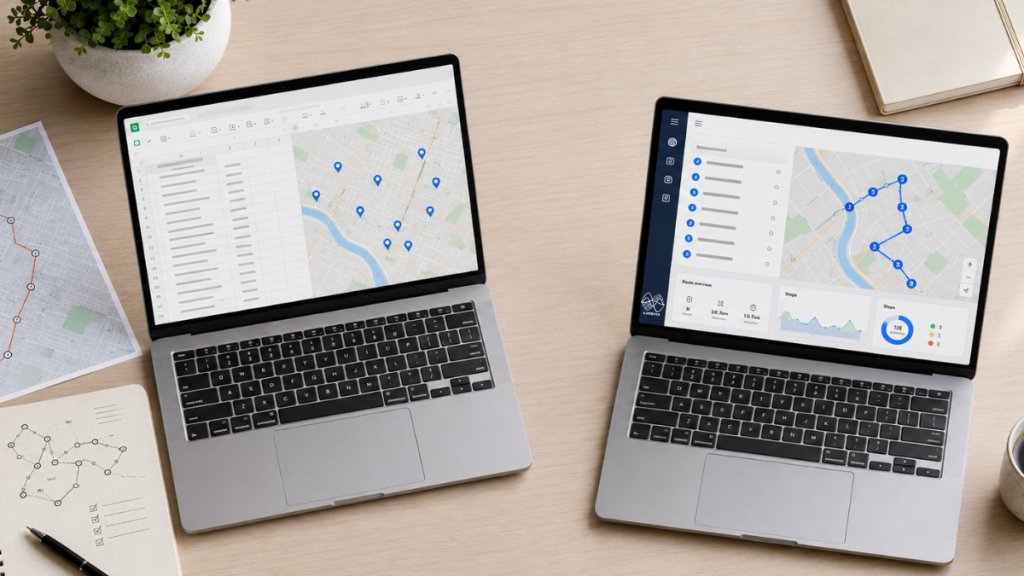
What is it about manual route planning that keeps logistics responsible away from investing in automated software? What are the benefits and the risks? How long does it take to output the route? And the 1000 points question, is it worth it?
Manual route planning – benefits and risks
Manual route planning has existed for as long as logistics have existed since humankind started traveling. Until recent years, automated planners were a luxury only large companies could afford. But to this day, many operators prefer to work offline, using the traditional pen and paper. Let’s explore the most common reasons.
| Benefits | Risks |
| No extra costs with software | Extra hours on the task |
| Many free options | No optimization options, manual ordering |
| Drivers should already know the routes | No data to track for improvements |
| No ramp-up time to learn another software | One step behind the competition |
| Knowledge already acquired | Human errors |
Automated route planning – benefits and risks
Changing the work procedures is never easy, especially when the employees have been used to that way for many years. They think they are fast and will find many flaws in the beginning just to prove they don’t need a change.
Automated route planners come with both benefits and risks that should be thoroughly understood. Let’s explore the greatest benefits and risks you should be aware of.
| Benefits | Risks |
| Save time routing hundreds of stops in minutes | Costs more initially |
| Customers feel like you have a super team | Raising standards and keeping them up |
| Full transparency | Onboarding takes longer |
| Accountability and data | Rely on a third-party provider |
| Solve many problems with just one tool | Adapting to a new work procedure |
Is there a winner?
Both manual and automated route planning come with benefits and risks, and it’s essential to clarify what your goals and needs are before making any decisions. You could list them on a simple piece of paper; it will do wonders to clarify everything. There are a few questions you can consider to make the best decision for your team and for your business.
How much time does the current route planning take?
When you plan your current routes with your current working style, how much time do you spend doing them? Minutes? Hours? Is there anything else you could do at that time? These questions should clarify whether you need to change the route planning work style to a more efficient one.
How happy are your drivers? Or clients?
Do you leave your drivers to plan the routes spontaneously from stop to stop, or which one is next? Or after you plan the routes, how happy are the drivers with your choices? Do they respect your route or go in a different way? And more importantly, how do your clients feel about their delivery experience? Look for the reviews they leave and how they feel when they call for an order status update.
Are there other benefits besides routing from an automated solution?
Look for the features the route planners offer. Ask questions to the team and try the platform during the free trial. Is there anything, in particular, you are looking for? Do your drivers start and end the route in different locations? Do they prefer a printed version? All these, and more, are legitimate questions you should ask yourself before looking into an automated route planner.
How long does it take to onboard every member of the team?
The platform of your choice should have an easy and short onboarding process. It should be easy to understand for you and your team. Consider the simplicity of the platform, the easiness to use, and the friendliness of the team behind the platform, as they’re going to be important for special requests and the maintenance of the platform.
Why not both?
What if we told you there’s a platform that has both options, manual and automated?
Yes, it’s possible with Logistia Route Planner. You can route your orders entirely automatically between all your drivers with only 1 click, or assign the orders to a driver manually using all our instruments to do that. Or combine them to speed up the process to a few minutes of work.
Curious about it? Create your account and check it out. And we’d love to have a chat with you. 🙂